
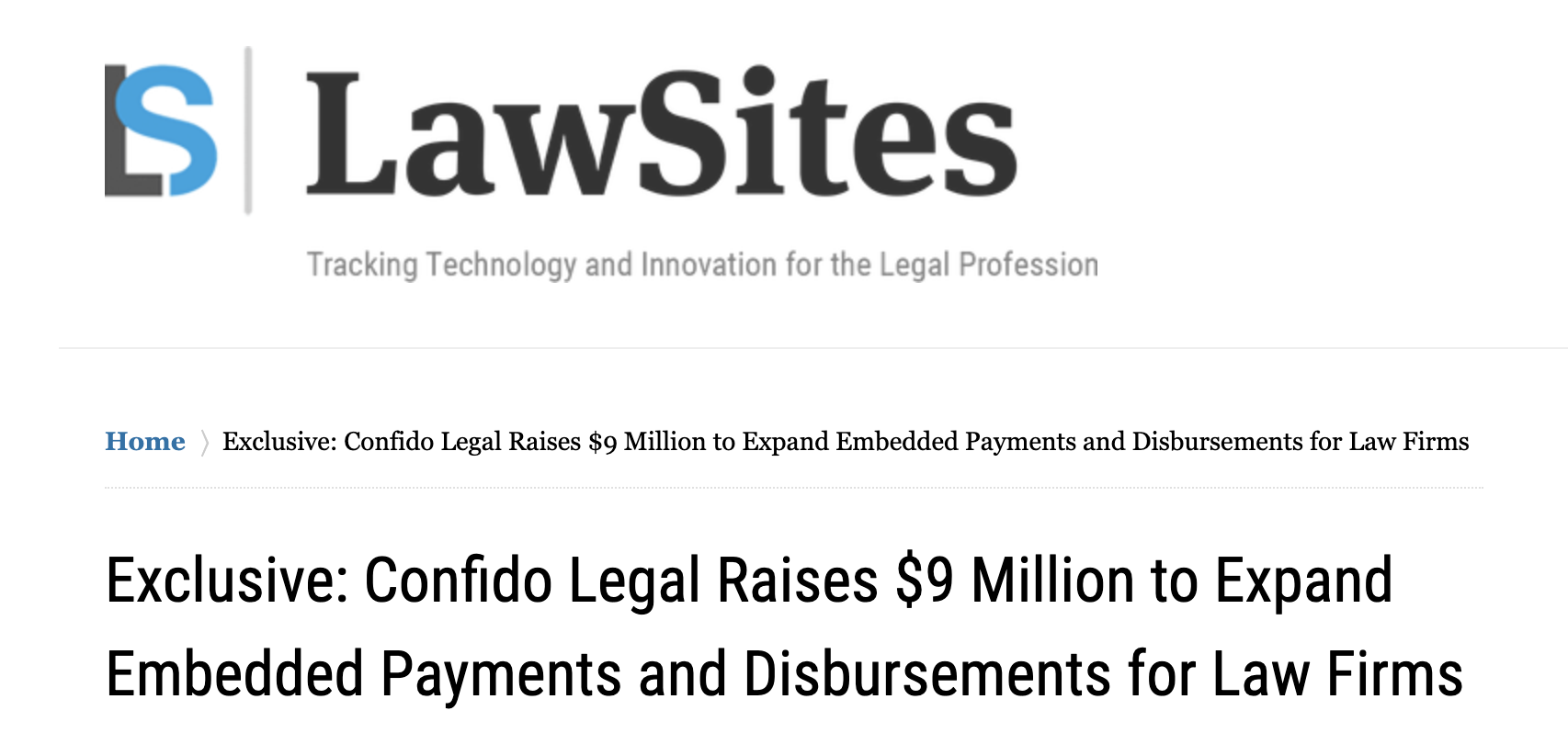
We’re excited to share that Confido was recently featured in LawSites, one of the publications closely following developments in legal technology. We appreciate their coverage and the recognition of the work we’re doing to build financial infrastructure designed specifically for the legal industry.
The article highlights the broader shift happening across legal technology as more platforms look to embed financial workflows directly into their products. Law firms operate within strict compliance frameworks around trust accounting, client funds, and settlement distributions, and many traditional payment systems were never built with those requirements in mind.
That’s the gap we’re focused on addressing.
Our platform provides the underlying infrastructure that allows legal technology companies to embed capabilities like payment acceptance, trust account management, and digital disbursements directly into their products. By integrating these financial tools into the systems law firms already use, platforms can simplify workflows while maintaining the compliance standards required in the legal industry.
As the LawSites article notes, modernizing how money moves through legal workflows is becoming an increasingly important part of the broader legal technology ecosystem.
The article also mentions our recent funding rounds, which brought total capital raised to $9 million. That funding allows us to continue investing in the platform and expanding the financial capabilities available to our partners.
One area we’re particularly focused on is digital disbursements. Many settlement payments and related transactions still rely on manual processes like paper checks. We’re building infrastructure that allows those funds to move digitally while maintaining the safeguards required for client trust accounts.
Coverage like this reflects a broader shift happening in the legal industry as financial workflows continue to modernize. As that shift continues, we’re focused on building the infrastructure that helps legal technology platforms support it.
Read the full article here.
Let us help reduce the cost and improve the client experience associated with accepting payments.
